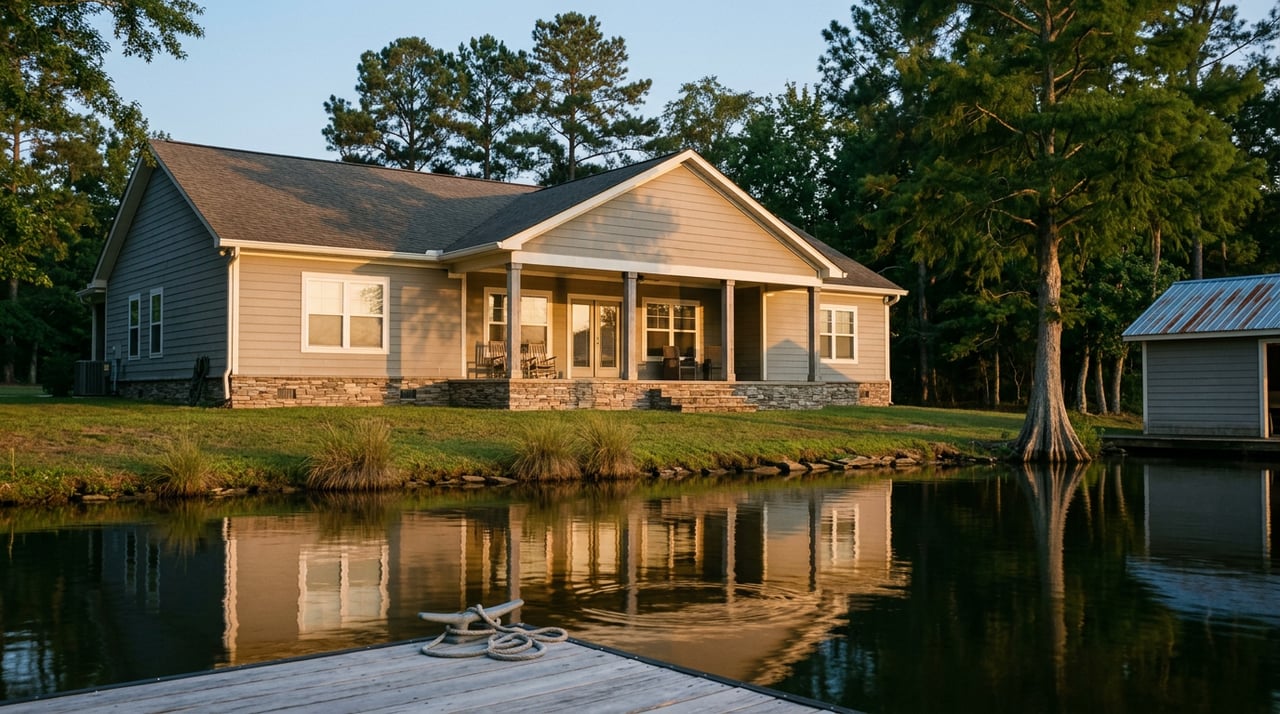
Waterfront usually costs more. That is the assumption baked into almost every housing market in the country, and it is the first thing that breaks when you actually look at the numbers for Lake Jacksonville.
As of this summer, waterfront homes on Lake Jacksonville were listing at a median price around $227,000. Meanwhile, the average home price across the city of Jacksonville, Texas hit $421,819 in August 2026, according to HAR's MLS-sourced data, after sitting even higher at $482,860 in June. Read those two numbers side by side and the town's signature natural feature looks like its discount aisle, not its premium address.
That is not a bargain. It is the market pricing in something most buyers do not find out about until they are already under contract.
The Numbers That Don't Line Up on Purpose
Here is the comparison as it stood over the past few months:
| Segment | Price | Source period |
|---|---|---|
| Jacksonville citywide average | $421,819 | August 2026 (HAR MLS) |
| Jacksonville citywide average | $482,860 | June 2026 (HAR MLS) |
| Jacksonville citywide median list | $364,000 | July 2026 |
| Lake Jacksonville waterfront median | $227,000 | Mid-2026 |
Notice that the citywide average itself swings by more than $60,000 in two months. That is a separate problem worth understanding, and I will come back to it. But the gap that matters most to a lake buyer is the one between that citywide number and the waterfront median. In most East Texas markets, water frontage pushes a price up. On Lake Jacksonville, it does not, and the reason has nothing to do with the quality of the homes.
What a "Lake Lot Lease" Actually Means
Lake Jacksonville is the city's primary water source and it covers about 1,325 acres a few miles southwest of downtown. The city built it, the city manages the dam and dredging, and the city owns a large share of the land the houses around it sit on.
If you buy a typical home on Lake Jacksonville, you are very likely not buying the ground underneath it. You are buying the structure and taking over a ground lease with the City of Jacksonville. The city has a standing payment system for this exact purpose, where lake residents pay their Lake Lot Lease the same way they pay a water bill. It shows up on the city's own site as a routine account you set up and maintain for as long as you own the house.
That is a fundamentally different transaction than buying a house on land you hold outright. You own the walls and the roof. The city owns the dirt.
Why "No Lake Lease" Became a Selling Point
You can see the effect of this in how agents actually market lake listings. Scan enough Lake Jacksonville properties and you will notice something odd: some listings lead with a line like "NO LAKE LEASE, fee simple," treating the mere fact of full land ownership as the headline feature of the house, ahead of square footage, ahead of the view, ahead of the dock.
That only happens because fee-simple lots on the lake are the exception. When something is the norm, nobody advertises it. When a seller can say their buyer will actually own the land the house sits on, that becomes the first thing worth mentioning, because everyone shopping the lake already knows to ask.
The properties that get labeled this way are not accidents. They tend to sit at the edges of the lake footprint, on lots that were platted before or outside the city's leasehold system, or on larger acreage where the shoreline is incidental to a bigger private parcel. Everything else, the classic dock-and-boathouse cottage on a tight lakefront lot, is more likely sitting on leased city ground.
The Financing Wall Nobody Mentions Until the Appraisal
Leasehold land changes how a house can be financed. Many conventional lenders either decline to write a standard 30-year mortgage against a home on leased land or require the remaining lease term to run well beyond the loan term, with specific language covering what happens if the lease is not renewed. Some buyers end up needing a portfolio loan or a local bank that already understands the Lake Jacksonville arrangement, rather than a standard secondary-market mortgage.
That financing friction shrinks the buyer pool. A smaller buyer pool means less competition at resale. Less competition at resale means the price stays lower than a comparable home on land the owner controls outright. The $227,000 median is not a discount waiting to be corrected. It is the equilibrium price for a house you can enjoy fully but never fully own the ground beneath.
This is also why a fee-simple lake lot tends to hold its value differently over time than a leased one. The leased lot's ceiling is set in part by financing terms, not just by the house itself. A buyer stretching every dollar toward a lake view should know which side of that line their target property sits on before they fall in love with the dock.
The Citywide "Average" Has Its Own Problem
I mentioned the swing between June's $482,860 average and August's $421,819. That is not a market correcting itself in eight weeks. It is a small MLS pool getting reshuffled by a handful of high-end sales entering or leaving the count in a given month. Movoto's median list price for the same window sat at $364,000, and the median price per square foot came in around $170, both notably below the MLS average.
When a market this size sells a few large acreage estates or new-build homes on the high end in one month, the average jumps. When those same homes close and roll off the active list, the average drops back down. None of this reflects what a typical Jacksonville buyer will pay. It reflects how sensitive a small sample is to a few outlier transactions.
The lesson for anyone comparing Jacksonville to other towns is the same lesson the lake teaches on its own: a single citywide number, whether it is an average or a median, tells you almost nothing about what you will actually pay in a specific pocket of town. You have to ask which segment that number is describing.
What This Means If You're Looking at Lake Jacksonville
Before you get attached to a listing on the water, a few things are worth confirming early, ideally before you write an offer:
- Ask directly whether the lot is fee simple or under a City of Jacksonville lake lot lease, and get the lease terms in writing if it applies.
- Check with your lender early about whether they will finance a leasehold property on Lake Jacksonville, since not every lender will, and the ones that do may require a larger down payment.
- Compare the property against the citywide median for its type and size, not the citywide average, since the average is being pulled around by a small number of high-value sales each month.
- If land ownership matters to you long-term, expect to pay a premium for a genuinely fee-simple lakefront lot, since sellers already know it is scarce enough to advertise.
None of this makes Lake Jacksonville a lesser place to live. People pay a lease bill and get three public access points, a lake that supports bass, crappie, and sunfish, and a five-minute drive to downtown, all for a fraction of what waterfront costs almost anywhere else in East Texas. The point is knowing what you are actually buying before you compare it to a house across town that comes with the deed to the ground it stands on.
If you are weighing a lake property against something in town, or you just want someone to walk the lease paperwork with you before you make an offer, Norton Property Group can pull the specific lot history and lease terms for any Lake Jacksonville address you are considering. Reach out for a free home valuation and we will tell you straight what you are looking at.