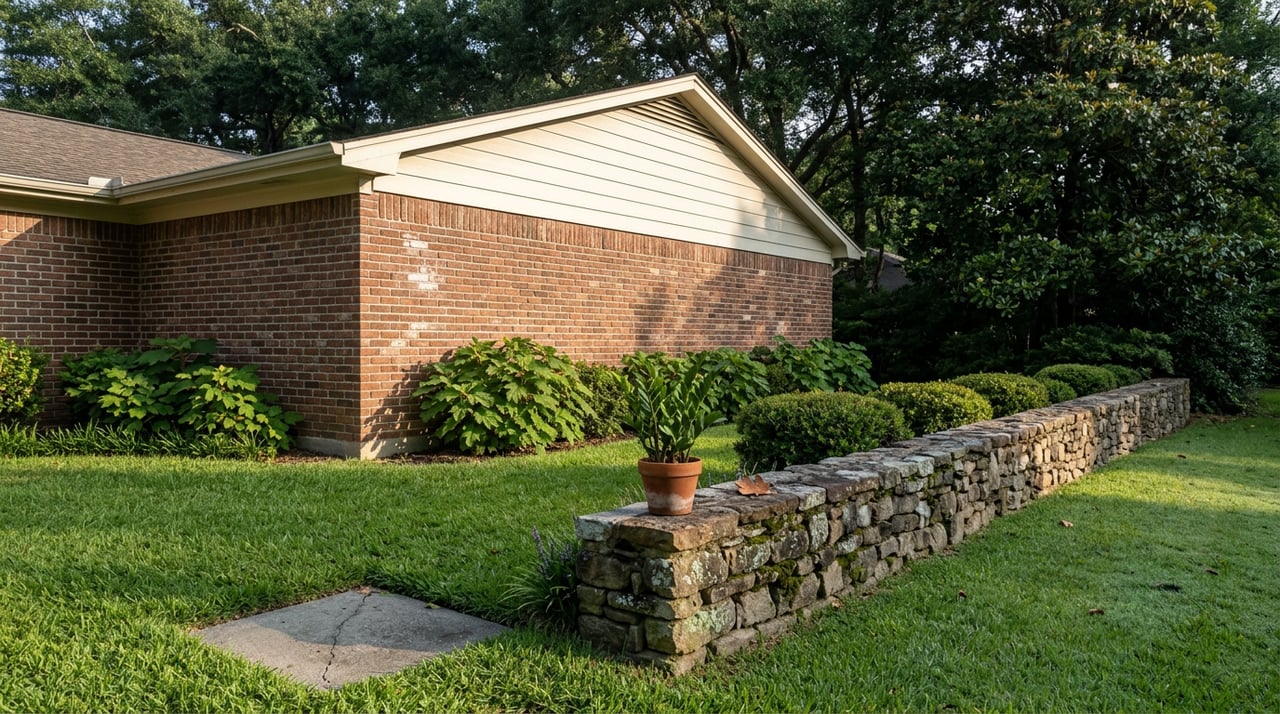
Three cleared lots sit at the corner of College Drive and U.S. Highway 59, inside Crown Colony, Lufkin's golf-course subdivision platted more than fifty years ago. The dirt has been graded since 2024. Nothing has been built. What was supposed to be an 8,000-square-foot RaceTrac travel center, with overnight parking for as many as 17 tractor-trailers, has instead become one of the longer-running property disputes in Angelina County, and, as KTRE reported, as of this writing it is sitting in front of the Texas Supreme Court for a second time.
That case is not really about a gas station. It's about a question every Lufkin buyer should be asking and almost none of them do: when a subdivision says it's "deed restricted," who actually has the authority to enforce that, and does the paperwork prove it? At the same moment this fight plays out in court, Lufkin's city council rewrote its industrial zoning rules for the first time in 16 years, and city and county officials jointly asked the state legislature for power neither of them currently has. Put those three threads together and you get a clearer picture of what protects a property's value in this market than any median price ever will.
The Fight Over Three Lots in Crown Colony
RaceTrac bought Lots 2, 3, and 4 of Crown Colony Section I in August 2023 for $2.45 million from 2007 Blue Hole Partners Ltd, a holding company controlled by Trey Henderson and Don and Lynda Langston. According to the Lufkin Daily News, Section I had been platted back in 1971 with restrictive covenants attached: setback requirements and a mandate that any new construction get approval from the subdivision's Architectural Control Committee. Before selling to RaceTrac, Blue Hole filed a document releasing those three lots from the restrictions entirely.
According to KETK, the Crown Colony Improvement Association sued in May 2024 to stop construction. The Lufkin Daily News reported that in July 2024, following testimony in Angelina County's 217th District Court, Judge K. Michael Mayes granted a temporary injunction. His reasoning mattered more than the outcome: Section I had only two owners at the time of the release, Blue Hole and an apartment complex, and both would have needed to agree to drop the restrictions. Blue Hole couldn't do it alone. The Lufkin Daily News reported that the 12th Court of Appeals in Tyler upheld that ruling. RaceTrac asked the Texas Supreme Court to step in, and KTRE reported that on May 29, 2026, the court declined without issuing a written opinion.
That should have ended it. Instead, RaceTrac's next move changed the entire argument. On July 30, 2026, the company filed a motion for rehearing that no longer contests whether the restrictions existed. It now argues that the Crown Colony Improvement Association never had the right to sue over Section I in the first place, claiming the association was organized in 1978 to represent a separate part of the neighborhood, never owned property in Section I, and that Section I owners never paid dues to it or recorded any document giving it enforcement authority there. Whether that argument succeeds is still unresolved.
Set the legal outcome aside for a moment. The lesson for a buyer is already visible in how the case unfolded. A subdivision can have restrictions on record for over 50 years and still end up litigating, decades later, over whether the group enforcing them on residents' behalf can prove it's the right group to do so. A closing disclosure that lists deed restrictions tells you they exist. It does not tell you whether the entity standing behind them can actually make that stick if a well-capitalized buyer decides to test it.
The City Rewrote Its Own Rulebook in August
While that case sat with the Supreme Court, Lufkin was busy rewriting a different set of rules entirely. According to KTRE, in the first week of August 2026, the city council adopted the first substantial update to Zoning Ordinance No. 3368 since 2010, changing how industrial development is allowed to sit next to residential neighborhoods.
The new standards tie building height on industrial sites to their distance from the nearest residential property line, so a taller building now requires a proportionally larger setback. According to KETK, side and rear yard setbacks near single or two-family residential districts grow to as much as 20 and 30 feet. Landscape buffers become mandatory where industrial and residential zoning meet, and new screening and noise-mitigation rules cover generators and HVAC equipment; the Lufkin Daily News reported that generator testing is banned between 7 p.m. and 7 a.m. City Manager Kevin Gee said, "We're seeing a renewed wave of interest from industrial and manufacturing investors looking at our community."
Part of that interest is data centers. Angelina County officials confirmed in June 2026 that a company called Amp Z is planning a data center at the former paper mill property on State Highway 103, and local reporting indicated other data center proposals had surfaced as well, though officials cautioned that power availability meant not every one would move forward.
Here's the detail that matters for a buyer weighing where in Lufkin to put down money: this ordinance only applies inside city limits, and only to new industrial projects or to expansions that grow an existing building by 10% or more. Businesses already operating continue under the old rules as legal nonconforming uses. And it doesn't reach a single acre outside the city line, because Texas counties have no zoning authority at all. That gap is exactly why Lufkin's city council and the Angelina County Commissioners Court passed a joint resolution the same week asking the state legislature to grant counties the power to regulate large industrial and energy projects outside city limits.
Three Different Rulebooks Cover the Same County
Line these two stories up and a pattern comes into focus that a median price or a listing sheet will never show you. Depending on which specific parcel you're considering, one of three separate systems decides what can move in next door, and they don't overlap the way most buyers assume.
- Inside Lufkin city limits, new industrial development is now covered by a public, city-enforced ordinance with defined setback, buffer, and noise standards, current as of August 2026.
- Inside a deed-restricted subdivision like Crown Colony, protection depends on private, recorded covenants tied to the specific section you're buying into, enforced only if the association or owners behind them can prove standing, which is the live question in front of the Texas Supreme Court right now.
- On unincorporated county acreage, like the former paper mill site off Highway 103, neither system applies unless that specific parcel carries its own deed restrictions, because Texas counties simply have no zoning power.
For a buyer, that means the phrase "deed restricted neighborhood" tells you less than it sounds like it should. So does "inside the city limits." The real due diligence question is narrower and more specific: which of these three rulebooks actually covers this parcel, and who can prove they have the authority to enforce it.
What to Actually Check Before You Sign
A few questions are worth asking for any Lufkin property before you write an offer, whatever part of the county it sits in:
- Pull the recorded plat and restrictions for the exact section, not just the subdivision name. Crown Colony has twelve numbered sections, and Section I's history shows restrictions can differ from one section to the next.
- Ask who is named as the enforcing entity for those restrictions, and whether that authority was ever separately recorded, rather than assumed.
- If the property sits inside Lufkin city limits, confirm whether any nearby parcel is zoned for light or heavy manufacturing and whether it predates the August 2026 ordinance, since existing operations are grandfathered.
- If the property sits outside city limits, don't assume the absence of zoning means the absence of restrictions. Check the deed directly, and check what's proposed on adjacent county land.
FAQ
Does a subdivision with deed restrictions automatically have an HOA with the power to enforce them? Not necessarily. Crown Colony's restrictions have existed on paper since 1971, and the association enforcing them is still defending, in an active Texas Supreme Court filing, that it has the legal standing to do so for that specific section.
Do Lufkin's new industrial zoning rules apply to businesses already operating near a neighborhood? No. The ordinance adopted in early August 2026 applies to new industrial development and to expansions that grow an existing building by 10% or more. Current operations continue as legal nonconforming uses.
If I buy land in unincorporated Angelina County, are there any rules at all? Zoning doesn't apply, since Texas counties have no zoning authority. Private deed restrictions on that specific parcel are also worth checking directly rather than assuming either protection or its absence.
Whether you're looking at a lot inside Crown Colony, a home inside Lufkin's city limits, or acreage out past the loop, the paperwork behind a property tells a more specific story than its listing does. Norton Property Group can pull the actual recorded restrictions and current zoning designation on a specific address before you write an offer, not after. If you're weighing a property anywhere in the Lufkin market, reach out and get your free home valuation started with someone who reads the fine print first.
This article is general information, not legal, tax or financial advice. Consult a qualified professional about your situation.